
How To
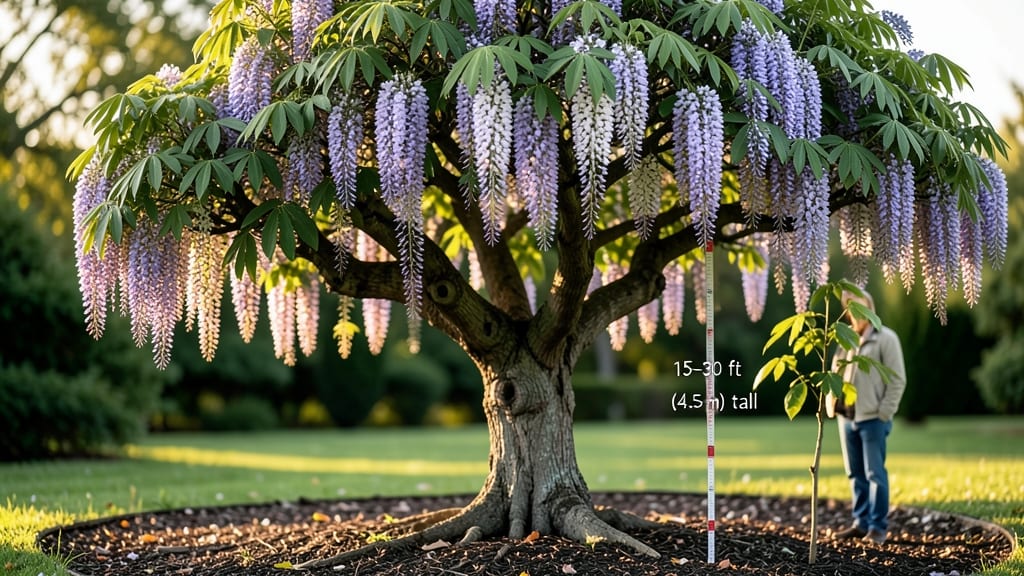
Wisteria tree height by variety: from dwarf to monster vines
Wisteria isn’t just one plant—it’s a family of vines with dramatic height differences. Some varieties creep along at 10 feet, while others become 50-foot giants that need a helicopter for pruning.
The key? Understanding your wisteria’s genetic growth habit and climbing style before planting. Let’s break down the height ranges by type, so you can pick the perfect fit for your space.
First, recognize that wisteria grows in two main forms: tree-form (like a shrub with a woody base) and vine-form (clinging to supports). Tree-form varieties tend to stay compact but still tall, while vines can sprawl uncontrollably if left unchecked.
For example, the Japanese wisteria (Wisteria floribunda) often grows as a vine, while Chinese wisteria (Wisteria sinensis) can take either form depending on training. American wisteria (Wisteria frutescens) is the most aggressive climber of all.
Here’s the hard truth: Most wisteria varieties will outgrow their welcome in small yards. Without pruning, a single vine can cover a house or fence in just a few years.
But don’t let that scare you off—with the right variety and care, you can enjoy wisteria’s fragrant blooms without the chaos. The secret? Choosing a slow-growing cultivar or committing to regular pruning.
Now, let’s dive into the height realities by variety. Below, you’ll see how Chinese, Japanese, and American wisteria compare, including their mature heights and growth rates.
Pro tip: If you’re in a small garden or urban space, focus on the dwarf or semi-dwarf options—though even those need training and pruning to stay manageable.
As you can see, Japanese and American wisteria are the fastest growers, while Chinese varieties like 'Amethyst Falls' offer a more manageable height for smaller spaces.
But here’s the catch: even dwarf wisteria can double in size within a decade if not pruned. That’s why I recommend planting near a sturdy
How to control wisteria growth: pruning secrets for small spaces
Wisteria’s rapid growth can feel overwhelming, but with the right pruning techniques, you can keep it manageable—even in tight spaces. The key is timing and method. Prune right after flowering (late spring to early summer) to encourage next year’s blooms while controlling height.
For aggressive varieties, tip pruning (cutting the growing tips) slows vertical growth by 30-50%.
If your wisteria is climbing a tree or fence, pollarding (cutting back main stems to 3-6 feet) forces bushier growth. This method is perfect for tree-form wisteria like ‘Blue Moon,’ which can reach 20+ feet without control. Always use sterilized pruners to prevent disease spread between cuts.
Support structures are non-negotiable. Train vines on a trellis, arbor, or sturdy fence—wisteria can weigh 50+ pounds per vine when mature. Use soft ties (like garden twine) to guide growth without damaging bark. For container-grown wisteria, prune 50% more aggressively since root space is limited.
Seasonal pruning matters too. In late winter, remove dead wood, and in fall, cut back any overly vigorous shoots that threaten your garden’s layout. Avoid heavy pruning in summer—it stresses the plant and reduces next year’s flowers.
Think of it like haircut maintenance: regular, light trims keep it shaped and healthy.
For small gardens, consider dwarf varieties like ‘Royal Purple’ (10-15 ft) or ‘Prolific’ (15-20 ft with pruning). These stay compact but still deliver abundant blooms. Even with these, annual pruning is essential—wisteria’s nature is to climb, and without guidance, it will dominate any space.
Remember: Wisteria’s height isn’t set in stone. With consistent pruning and support, you can enjoy its stunning fragrant blooms without sacrificing your garden’s layout. Start small, prune often, and watch your wisteria thrive—without the wild sprawl. 🌿✂️🌸