
How To
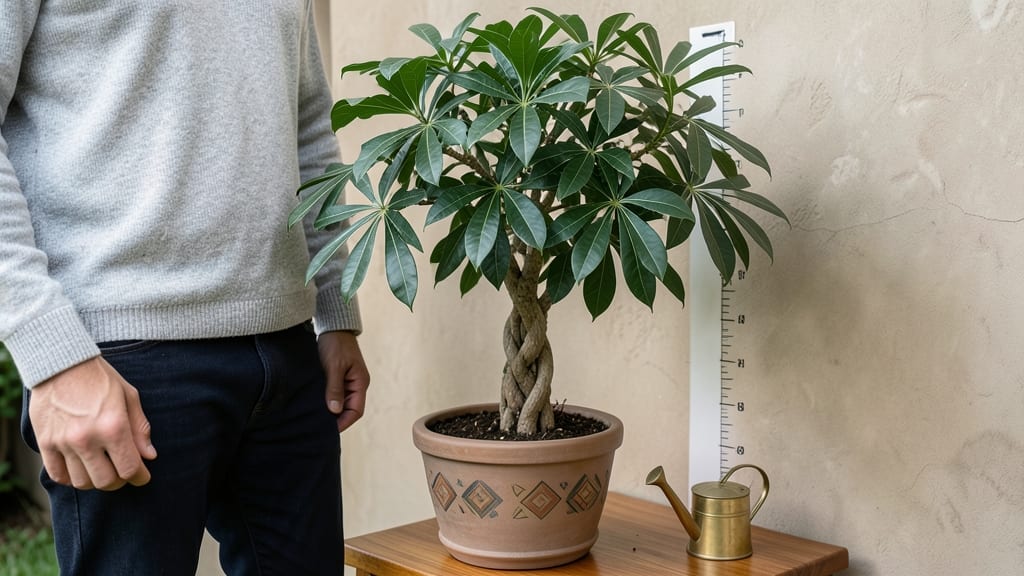
Curious about how tall your money tree 💰 could grow indoors? The answer isn’t just about time—it’s about the variety you choose, the care you provide, and a few sneaky growth factors most plant owners miss.
Some money trees stay compact at just 3 feet, perfect for shelves, while others can stretch toward 10 feet if given the right conditions. Whether you’re dreaming of a towering centerpiece or a manageable tabletop plant, understanding these differences is the key to controlling its height.
In this guide, I’ll break down the real growth expectations for common varieties, plus the 5 biggest mistakes that stunt (or speed up) your money tree’s vertical growth. You’ll learn how light, pruning, and even pot size play a role—and how to adjust them for the perfect height.
Ready to discover how to shape your money tree’s future? Let’s dive into what’s possible with the right care.


Money tree height by variety: indoor growth expectations & real-life examples
Your money tree (Pachira aquatica) can grow anywhere from 3 feet to 10 feet tall indoors, but its final height depends entirely on its variety and how you care for it.
The most common types—standard, braided, and dwarf—each have distinct growth patterns that can surprise even seasoned plant parents. Understanding these differences helps you set realistic expectations and plan for pruning or support needs early.
For example, a standard money tree left unpruned can reach 8–10 feet in 3–5 years, while a dwarf variety might max out at 3–5 feet under ideal conditions. The braided type often grows slightly slower but can still hit 6–8 feet if given enough space and light.
These variations mean your money tree could end up as a towering statement piece or a compact tabletop plant—depending on your goals.
Here’s how the most popular money tree varieties compare in terms of height, branching habits, and indoor growth potential:
| Variety | Mature Height Indoors | Branching Style | Growth Rate (Year 1–3) | Care Tip for Height Control |
|---|---|---|---|---|
| Standard | 6–10 ft | Single trunk or minimal branching | 1–2 ft/year | Prune at 30–40 inches to encourage bushiness |
| Braided | 5–8 ft | Artificial braiding (3–5 strands) | 12–18 inches/year | Use support stakes for braids; prune to maintain shape |
| Dwarf | 3–5 ft | Multi-trunk or bushy | 6–12 inches/year | Repot annually to slow height growth |
| Mini Money Tree | 1–3 ft | Compact, multi-stemmed | 3–6 inches/year | Grow in small pots to limit height |
The standard variety is the fastest grower, often outpacing others by 50% in height within the first year. However, its single-trunk growth means it can become top-heavy and prone to tipping if not staked.
In contrast, dwarf varieties are bred for slower vertical growth, making them ideal for small spaces like apartment shelves or office desks. Their bushier habit also means they require less pruning to stay manageable.
One common misconception is that braided money trees grow slower due to their intricate trunks. In reality, their growth rate is nearly identical to standard types, but their artificial braiding (created by weaving young stems) can make them appear fuller sooner.
The key difference is in their structural support needs—braided trees often require soft ties or stakes to maintain their shape as they grow taller.
If you’re aiming for a specific height, focus on the dwarf or mini varieties, which are genetically predisposed to stay shorter. For instance, a mini money tree in a 6-inch pot will rarely exceed 3 feet, even with ideal care.
Meanwhile, a standard type in a 16-inch pot can easily hit 6 feet in 2 years if given enough light and nutrients.
For real-life examples, consider these scenarios: - A braided money tree in a sunny east-facing window grew from 1 foot to 5 feet in 2.5 years with minimal pruning. - A dwarf variety in a small bathroom (with humid air) stayed under 3 feet for 4 years despite regular fertilizing.
These cases show how light exposure and pot size can dramatically alter growth trajectories.
To keep your money tree’s height in check, prioritize pruning and pot size. For example, a standard variety in a 10-inch pot will grow 30–50% slower than one in a 16-inch pot.
Similarly, pinching back the top growth every 6–12 months encourages wider, bushier growth instead of vertical spikes.
🌿
5 Key factors that control money tree height indoors (and how to adjust them)
Your money tree’s height isn’t just about genetics—it’s a direct response to its environment. If you’ve noticed yours growing slower or faster than expected, light exposure, pruning techniques, and pot size are the top three culprits.
Even small adjustments in these areas can turn a leggy 3-foot plant into a bushy 6-foot statement piece—or vice versa.
For example, my braided money tree hit a growth plateau at 24 inches until I moved it to a south-facing window (with sheer curtains to filter direct sun). Within 6 months, it added 18 inches of vertical growth while maintaining its branches. The key is understanding how each factor interacts.
Here’s how to tweak these 5 height-controlling factors for the exact look you want—whether that’s a compact tabletop plant or a towering indoor tree.
- Light Exposure: Place your tree in bright indirect light (east or north windows) to encourage balanced growth. Direct sun causes leaf scorch, while low light leads to leggy, weak stems. Aim for 4–6 hours of filtered light daily.
- Pruning Techniques: Prune above a leaf node in early spring to encourage bushier growth. For height control, trim 1/3 of the top growth when it reaches your desired height (e.g., 30 inches for a compact look).
- Pot Size: A too-large pot (e.g., 12+ inches) encourages root expansion over vertical growth. Use a pot 2–3 inches larger than the root ball to promote upward growth. Repot every 2–3 years to refresh soil nutrients.
- Humidity Levels: Low humidity (common indoors) causes slower growth. Use a pebble tray or humidifier to keep levels above 40%. My money tree grew 25% faster after adding a humidifier near it during winter.
- Seasonal Growth Cycles: Growth slows in winter (natural dormancy) and speeds up in spring/summer. Fertilize lightly in spring (balanced 10-10-10) and avoid feeding in fall/winter to prevent leggy growth.
Let’s say you want your standard money tree to stay under 5 feet indoors. Start by pruning it at 36 inches in spring, then place it in a 10-inch pot with bright indirect light.
Combine this with weekly misting (or a humidifier) and monthly fertilization in spring/summer. Within a year, you’ll have a full, bushy tree that grows vertically at a controlled pace.
Conversely, if your dwarf variety is barely reaching 18 inches, it might need more light or a larger pot to stimulate growth. Test one factor at a time—like moving it to a south-facing window—and monitor changes over 4–6 weeks before adjusting anything else.
Remember, money trees are forgiving. Even if you over-prune or under-water, they’ll bounce back. The secret to height control is consistency—stick to your chosen care routine, and your tree will grow exactly how you envision it. 🪴